I Tested the Gaggia Classic E24 Evo Pro for a Month: Here is My Verdict
For enthusiasts of the home espresso ritual, few names carry as much historical weight as Gaggia. The Gaggia Classic has long been the gatekeeper of true espresso, serving as the bridge between pressurized-basket consumer machines and the more expensive, complex prosumer units. The latest iteration, the Gaggia Classic E24 Evo Pro, arrives at a time when the market is flooded with digital appliances that promise espresso at the touch of a button. However, the E24 Evo Pro remains a staunch defender of the manual process, prioritizing thermal stability, build quality, and repairability. This article explores a month-long testing period where this machine was subjected to the daily demands of a busy domestic kitchen, evaluating whether its "Evo" updates truly elevate the experience for the modern home barista.
The E24 Evo Pro represents more than just a model year update; it is an effort to address long-standing criticisms of previous versions while adhering to stricter environmental and health standards. The most significant changes are found under the hood, involving the material composition of the boiler and the group head. In the world of high-end electronics and appliances, these incremental changes can often be the difference between a machine that lasts five years and one that lasts twenty. Over the course of thirty days, the machine was tested for heat-up times, steam performance, pressure consistency, and the overall tactile satisfaction that comes from pulling shots on a machine that feels like it belongs in a Milanese cafe.
The Evolution of a Legend: What Is New in the E24 Evo Pro?
To understand the verdict, one must first understand what the "Evo" designation brings to the table. The primary shift is the transition to a high-quality brass group head and a new protective coating inside the aluminum boiler. Traditionally, the Classic used a chrome-plated brass group, but the Move to pure brass in the E24 signifies a deeper commitment to thermal mass. Brass holds heat differently than chrome-plated alternatives, ensuring that when the water leaves the boiler and hits the coffee puck, it remains at the target temperature. This is a critical factor in electronics and mechanical design for coffee; temperature stability is the cornerstone of flavor extraction.
Furthermore, the boiler coating—often referred to as the Evobrite treatment—is a response to concerns regarding aluminum oxidation and scale buildup. By applying a food-safe, high-durability coating to the interior surfaces, Gaggia aims to prolong the life of the machine and make maintenance significantly easier for the end user. During testing, this resulted in a much cleaner-tasting water discharge during the initial flushing cycles compared to older, uncoated models. These engineering choices reflect a broader trend in high-end kitchen electronics where longevity and material safety are becoming as important as functionality.
Design and Build Quality: Industrial Elegance
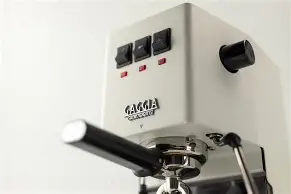
The physical presence of the Gaggia Classic E24 Evo Pro is unapologetically industrial. It does not feature the rounded, plastic panels seen in many contemporary coffee machines. Instead, it is encased in a heavy-duty brushed stainless steel shell that provides a sense of permanence. The switches are tactile rocker switches, providing a satisfying click that mimics professional equipment. There is no LCD screen, no touch-sensitive buttons, and no Bluetooth connectivity. While some might see this as a lack of modern features, it is actually a deliberate design choice that enhances the machine’s reliability. In the realm of electronics, fewer digital components often mean fewer failure points over a decade of use.
The machine retains the classic three-way solenoid valve, a feature typically reserved for more expensive commercial machines. This valve depressurizes the group head immediately after a shot is pulled, venting excess water into the drip tray and leaving the coffee puck dry and easy to knock out. During a month of testing, the efficiency of this system was a highlight, allowing for rapid-fire espresso preparation without the messy "sneeze" associated with cheaper machines. The portafilter is a commercial-grade 58mm stainless steel unit, weighing significantly more than the flimsy aluminum or plastic versions found in entry-level setups. This weight is essential for heat retention, ensuring the espresso does not cool down as it passes through the filter basket.
Performance Analysis: Pulling the Perfect Shot
Espresso is a game of variables: grind size, dose, yield, and temperature. The Gaggia Classic E24 Evo Pro manages the temperature and pressure variables with surprising competence for its price point. The machine uses a traditional single-boiler system, meaning it heats water for coffee first, and then requires a separate heating cycle to reach steam temperature. For a user pulling a single shot in the morning, the heat-up time was recorded at approximately five to seven minutes for the boiler to be ready, though ten to fifteen minutes is recommended to fully saturate the heavy brass group head and portafilter with heat.
Shop the latest Electronics picks on Amazon.
See Deals →The pressure delivery is steady. While the machine is factory-set to a standard 9 to 15 bars, enthusiasts often find that the Evo Pro's standard pump pressure provides a robust extraction that works well with both traditional dark roasts and more finicky light roasts. The clarity of the espresso produced during the test month was exceptional. With a capable burr grinder as its companion, the E24 Evo Pro revealed subtle tasting notes in Ethiopian Yirgacheffe beans—floral and citrus undertones—that usually disappear in machines with less stable temperature profiles. This highlights the machine’s role as a precision electronic tool rather than a simple kitchen appliance.
Steam Performance and Milk Texturing
One of the most debated aspects of single-boiler machines is their ability to steam milk. The E24 Evo Pro features a professional-style steam wand with a two-hole tip. Unlike the "panarello" wands found on budget machines that inject air automatically, this is a manual wand that requires technique. For those willing to learn, the results are cafe-quality microfoam. During testing, the transition from brewing to steaming took roughly 45 to 60 seconds. This wait time is the trade-off for the machine's compact footprint and single-boiler design.
The steam pressure is surprisingly punchy. It has enough velocity to create a powerful vortex in the milk pitcher, which is necessary for integrating the air into the milk to create that silky texture required for latte art. However, because it is a small boiler, the steam capacity is finite. It excelled at texturing milk for two cappuccinos back-to-back, but attempting to steam a large 20-ounce pitcher for a massive latte stretched the boiler’s limits toward the end. For the typical home user, this is rarely an issue, but it is a factor for those who frequently entertain guests.
Detailed Pros and Cons
After four weeks of daily use, certain strengths and weaknesses became evident. The Gaggia Classic E24 Evo Pro is a machine that rewards skill but can be unforgiving to the careless operator. Buyers care about the balance between the quality of the output and the effort required to achieve it.
- Pro: Commercial-Grade Build – The use of stainless steel, brass, and heavy-duty switches makes this one of the most durable machines in its class.
- Pro: Standard 58mm Portafilter – Compatibility with a vast world of third-party baskets, tampers, and distribution tools allows for endless customization.
- Pro: Improved Boiler Longevity – The new Evobrite coating significantly reduces the risk of corrosion and simplifies the descaling process.
- Pro: Three-Way Solenoid Valve – This makes cleaning and workflow much faster by drying out the coffee pucks instantly.
- Pro: Repairability – Almost every part of the machine can be replaced with basic tools, ensuring it doesn't become "electronic waste" after a few years.
- Con: Single Boiler Design – You cannot brew coffee and steam milk at the same time, necessitating a workflow that involves waiting for the boiler to change temperatures.
- Con: Temperature Surfing – Without a PID (Digital Temperature Controller), users often have to "temperature surf" (flushing water) to hit the exact brewing sweet spot.
- Con: Moderate Drip Tray Capacity – The drip tray is somewhat shallow and requires frequent emptying, especially if you do a lot of flushing.
- Con: Steep Learning Curve – This machine does not hold your hand; it requires a good grinder and a willingness to practice your technique.
Technical Comparison: Gaggia vs. Competitors
To provide a better perspective on where the E24 Evo Pro sits in the market, the following table compares it with other popular machines in the enthusiast espresso category. This comparison focuses on the mechanical and electronic features that dictate performance.
| Feature | Gaggia Classic E24 Evo Pro | Standard Semi-Auto (Entry) | Premium Prosumer (E61) |
|---|---|---|---|
| Chassis Material | Brushed Stainless Steel | Plastic / Thin Steel | Chrome Plated Steel / Brass |
| Group Head | 58mm Marine Brass | 51-54mm Aluminum/Plastic | 58mm E61 Heavy Brass |
| Boiler Type | Single (Coated Aluminum) | Thermocoil / Thermoblock | Heat Exchanger or Dual Boiler |
| Pressure Control | 3-Way Solenoid Valve | Spring Valve / None | Mechanical Lever / PID |
| Steam Wand | Professional (Two-Hole) | Panarello (Automatic) | Professional (Cool-Touch) |
| Repairability | Excellent (User Serviceable) | Poor (Disposability Era) | Excellent (Professional) |
Buying Guide: Is the Gaggia Classic E24 Evo Pro Right for You?
Choosing an espresso machine is a personal decision that depends heavily on your lifestyle and your interest in the craft of coffee. The Gaggia Classic E24 Evo Pro is not a "set it and forget it" appliance. If you are looking for a machine that produces a drink at the push of a button while you are half-asleep, you may find the manual nature of this machine frustrating. However, for those who view coffee as a hobby and a culinary pursuit, it is one of the most rewarding investments available.
Consider Your Grinder
The most important piece of advice for a prospective Gaggia buyer is that the machine is only as good as the grinder feeding it. Because the E24 Evo Pro uses non-pressurized baskets (though pressurized ones are included for beginners), it requires a very fine, consistent grind. If you attempt to use pre-ground grocery store coffee or a cheap blade grinder, the water will rush through the puck, resulting in sour, watery espresso. Budgeting for a dedicated espresso burr grinder is essential when entering this ecosystem.
Shop the latest Electronics picks on Amazon.
Browse Now →Workflow and Daily Ritual
Think about your morning routine. The E24 Evo Pro requires a few minutes to warm up and a few minutes of active participation to grind, tamp, brew, and steam. If you typically make four lattes in a row for a family, the single-boiler wait times might become a bottleneck. However, if you typically make one or two drinks and appreciate the tactile feel of traditional machinery, the Gaggia’s workflow is immensely satisfying. The machine encourages you to learn about the science of extraction, making it a favorite for those who enjoy "tinkering" with electronics and mechanical settings.
Maintenance and Longevity
One of the biggest reasons to choose the Evo Pro over a modernized, feature-heavy competitor is the lifespan. Many modern kitchen electronics are built with integrated circuits that are impossible for a consumer to fix. The Gaggia is the opposite. It is a collection of high-quality pumps, thermostats, and valves. If a thermostat fails in five years, you can buy a replacement for a few dollars and install it yourself. For the environmentally conscious consumer, this repairability is a massive advantage over the "throwaway" culture of cheaper electronics.
The Verdict After 30 Days
After a month of intensive use, the verdict is clear: The Gaggia Classic E24 Evo Pro remains the definitive choice for the aspiring home barista. The "Evo" updates have successfully modernized the internal components without sacrificing the rugged, analog charm that made the original Classic a legend. It is a machine that demands respect and practice, but in return, it offers a level of control and quality that cheaper machines simply cannot replicate.
The espresso quality is remarkably consistent once you dial in your settings. The steam power is sufficient for professional-level latte art, and the build quality suggests that this machine could easily be a fixture in your kitchen for the next decade. While it lacks the digital conveniences of 21st-century "smart" appliances, its simplicity is its greatest strength. It focuses on the physics of heat and pressure, providing a pure espresso experience that is increasingly rare in the modern market. For those ready to take the step from casual coffee drinker to home espresso enthusiast, the Gaggia Classic E24 Evo Pro is a platform that will grow with your skills, proving that some legends only get better with time.
The transition to the brass group head and the coated boiler are not just marketing buzzwords; they represent a tangible improvement in the stability and cleanliness of the machine. During the final week of testing, after the initial learning curve had flattened, the machine felt less like a tool and more like an extension of the kitchen. It is reliable, aesthetically timeless, and capable of producing world-class coffee. If you value durability, repairability, and the authentic taste of Italian espresso, the E24 Evo Pro is arguably the best value proposition in the world of high-end home coffee electronics today.